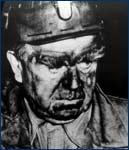
 President of the United Mine Workers of America (UMWA) from 1920 until 1960 and founding president of the Congress of Industrial Organizations (CIO), John Llewellyn Lewis was the dominant voice shaping the labor movement in the 1930s. The CIO owed its existence in large measure to Lewis, who was a tireless and effective advocate of industrial unionism and of government assistance in organizing basic industry.
John L. Lewis was born in Lucas, Iowa, on Feb.12, 1880, to Tom Lewis, a coal miner from Wales, and Ann Watkins, the daughter of a founder of the local Mormon church (RLDS). The first of seven children, Lewis completed nearly 10 years of formal education before joining his father in the mines at age 16. As a young man, Lewis served as the recording secretary of UMWA Local 1933. In 1901 he headed West, where he "rode the rails" for four years and experienced firsthand the hardships of workers across the country. Lewis returned to Lucas in 1905, and in 1907 married Myrta Edith Bell, the eldest daughter of one of Lucas County's most respected citizens. In later life, Lewis would credit Bell, with whom he had three children, as the single most important influence on his life.
The Lewises moved to Panama, Ill., where John was elected president of UMWA Local 1475. Lewis lobbied the Illinois legislature on behalf of workers' compensation and mine safety legislation, coming to the attention of Samuel Gompers, president of the American Federation of Labor (AFL). Hired as a national organizer and field representative, Lewis served the federation from 1910 to 1916, while working closely with the incumbent UMWA president, John P. White, to defeat socialist and radical insurgents seeking to control the union.
White named Lewis UMWA international statistician at the beginning of 1917. An able analyst and effective negotiator, Lewis quickly emerged as the dominant figure within the union's leadership. Cooperating with federal efforts to regulate mining production and labor relations during World War I, Lewis helped win substantial wage increases for miners in the central bituminous coal fields. And in the fall of 1917, after the appointment of the UMWA president to a position on the Federal Fuel Board, Lewis became the union's new vice president. He became acting president of the UMWA in 1919 and formally took over the job in 1920, when his predecessor resigned.
The 40-year-old Lewis now led the largest and most influential union in the country. In the early 1920s, Lewis used the nation's dependence on coal to maintain union membership despite severe economic downturns in the industry. He also guided the miners through a successful five-month strike to preserve the wage gains they had won during the war. The unionized mines faced intense competition from nonunion operators, however, and the entire industry suffered from the destructive effects of an unregulated boom-and-bust production cycle. With union membership declining from 500,000 in 1922 to 75,000 in 1933, Lewis lobbied hard for federal legislation that would stabilize the industry, guarantee workers the right to organize and "take wages out of competition."
Raised in a Republican household, Lewis had allied himself with the GOP during the 1920s. But after the Republicans lost control of Congress and Franklin D. Roosevelt was elected president in 1932, Lewis sought Democratic support for his ideas—and the Democrats proved more receptive than the Republicans had been. In 1933 Congress passed the National Industrial Recovery Act to regulate production, ensure stable employment and guarantee workers the right to organize and bargain collectively over the terms and conditions of their employment.
Gambling the union's dwindling treasury on an all-out organizing drive, Lewis flooded the coalfields with the message: "The President wants you to join the union!" Scarcely three months after the National Recovery Administration was established, 92 percent of all the country's coal miners were organized. Lewis next sought support from the AFL to organize other mass-production industries. His motion to make the AFL's Executive Council more representative was defeated at the AFL's 1933 convention, but when a similar motion passed in 1934, Lewis was named to the expanded council. At the same time, the AFL declared itself in favor of organizing on an industrial basis.
Initially optimistic about the future of industrial unionism in the federation, by the following May Lewis concluded that the federation's entrenched leadership was neither willing nor able to organize workers. At the 1935 convention, he led a no-holds-barred assault on the old guard, demanding they make good on their promises to organize and charter industrial unions. When his proposals were defeated, Lewis intentionally provoked Carpenters President William Hutcheson into calling him a name. Lewis leaped a row of chairs and knocked Hutcheson to the ground with a right to the nose. The blow sealed the breach between the AFL and the CIO and signaled to millions of workers across the country that they had a new champion in John L. Lewis.
Making full use of his instant notoriety, Lewis committed UMWA funds to support organizing drives in the rubber, auto and steel industries. Without this support, and without Lewis's involvement, it is doubtful whether these campaigns would have succeeded. Lewis assigned his own staff to assist each drive, remained in constant communication with them all and personally negotiated the agreements with General Motors and U.S. Steel.
In 1938, the CIO held its founding convention and elected Lewis its first president. Inspired by his stirring oratory and his bold demands on corporate power, millions of workers revered Lewis as the conscience of American industry and the embodiment of the new power of labor. Some commentators considered Lewis a contender for the presidency of the United States.
By the end of World War II, however, Lewis' national stature had diminished. In 1936, Lewis and Hillman had founded Labor's Non-Partisan League and helped re-elect President Roosevelt. But in 1940, frustrated with Roosevelt's war policies and his nonsupport of labor during the "little steel" strike of 1937, Lewis endorsed the Republican candidate for president. When American workers failed to follow his lead and abandon Roosevelt, Lewis resigned as president of the CIO. In 1942, he broke with the industrial union movement he had helped create and took the UMWA out of the CIO.
Thereafter, Lewis largely devoted himself to the UMWA, remaining a bold and visionary labor leader. Bitter mine strikes in 1943 and 1946 earned him the enmity of many, but Lewis persisted. As the coal industry slipped into a long, slow decline and oil replaced coal as the nation's No. 1 source of energy, Lewis fought to protect the income and employment security of miners. In 1948, the UMWA won an historic agreement establishing medical and pension benefits for miners, financed in part by a royalty on every ton of coal mined. The union also acknowledged management's right to automate and to close unprofitable operations. In return, it secured high wages and expanded benefits in the remaining mines.
In the 1950s, Lewis won periodic wage and benefit increases for miners and led the campaign for the first Federal Mine Safety Act in 1952. Lewis retired as president of the UMWA in 1960 and died at his home in Alexandria, Va., in 1969.